

Background
Over the past few years, computers and computer software have developed in ways not previously foreseen. We have advanced from using floppy disks to CDs to downloadable programs to cloud computing. The pace of this evolution of technology has not allowed the states to maintain a clear and uniform sales tax policy.
Early on, the taxation of software was simple because software was purchased as tangible property, off the shelf, in the form of floppy disks or CDs, such as games or word processing programs. Historically, sales tax was geared to taxing tangible personal property, so it was clear that this software was all subject to sales tax.
In time, technology allowed for electronic downloading of software so that the transfer of tangible personal property was not necessary. Most states then took the position that canned software would remain taxable while, in the case of custom software, some states took the position that removing the tangible component would eliminate its taxability.
In more recent years, the current software evolution has brought us to cloud computing. Cloud computing is the practice of using a network of remote servers hosted on the internet to store, manage, and process data, rather than using a local server or a personal computer. Cloud computing allows you to access complex software applications, databases, analytics, etc. over the internet, without having to own or rent a powerful computer or storage space. Examples are using tax preparation software or file-sharing sites like Dropbox to store data. Cloud computing that allows the user to access software remotely is referred to as Software as a Service or “SaaS.”
Today, businesses and individuals selling and purchasing software and digital goods and services are taxed numerous different ways by different states. Traditional software is still usually taxed as a tangible good. On the other hand, the taxation of SaaS usually revolves around whether it is also viewed as a tangible good, or an intangible good or a service.
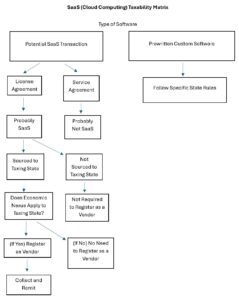
While SaaS is not a physical product, a complicated question still remains as to whether it is an intangible good or a service. In some states, its taxability depends upon whether its sale or purchase is pursuant to a licensing agreement or a service agreement. When a service agreement is present, taxability may depend on the nature of the transactions. If the service component is the primary purpose, SaaS may be non-taxable, whereas if access to software is the main objective, it is likely taxable.
Generally, where a license agreement is present, the transaction is taxable because the license is deemed tantamount to possession or control over the software as if it were tangible property. In some cases, it is relevant as to whether the user rights are temporary or permanent.
SaaS investments can increase the profits, capabilities, and competitiveness of a company. However, the rules for digital goods and services are convoluted and are constantly being challenged and changed. By way of example, the following items are taxed differently in the majority of states: SaaS; digital movies and photography; games; training software; installation of hardware; and software maintenance agreements.
After characterization of the basic transaction, at least two additional inquiries are necessary to help determine whether the transaction is taxable.
Sourcing
Determining the state to which the transaction is sourced is the next step in concluding whether the transaction is taxable. An analysis is required to determine where a sale is deemed to have occurred, to know which state’s authority applies to the transaction, and consequently, which state may have jurisdiction to require sales tax collection.
Consideration may need to be given to a specific billing address and/or the location where the purchaser uses or directs the use of the software, not the location of the software’s origin. This may also be multiple states.
Nexus
The final principal inquiry that needs to be covered is whether a vendor’s activities establish nexus or a minimum connection with the state. If nexus is established, the vendor is required to collect the sales tax from the consumer and remit it to the state.
Nexus was originally defined as “substantive physical presence” in a state by the U.S. Supreme Court in 1992. Then in 2018, the Court eliminated the requirement that a seller have a physical presence and adopted laws aimed at capturing sales tax from internet sales and online marketing activities. Many states now have economic nexus rules, which base the obligation to collect solely on dollar sales revenue or transaction volume in that state.
The following matrix provides general rules for taxing SaaS:
In closing, the sale of digital products and the delivery of services by new technologies which are borderless, create new challenges for all businesses. These days customers can be anywhere. While you cannot be an expert with the laws of every state or every country, SaaS investments can increase profits, enhancing the capabilities and competitiveness of a company. However, the failure to implement the correct sales and use tax rules may cut down the anticipated benefits of these investments and expose owners and officers to personal liability.
The tax attorneys at Barton LLP advise on all e-commerce issues and are available to guide you. If you have any further questions regarding tax on SaaS, please contact Alvan Bobrow.
 Alvan L. Bobrow