
At the end of 2017, Congress passed the Tax Cuts and Jobs Act of 2017 (TCJA) which made radical changes to the way the U.S. taxes cross-border income. One of the changes was the introduction of the Foreign Derived Intangible Income (FDII) deduction to encourage U.S. corporations to manufacture goods in the United States and then export these goods to non-U.S. markets.
If those manufactured goods were exported and remained outside the U.S., the U.S. manufacturer was eligible to deduct a portion of the income derived from those exports. Service businesses could also qualify if they provided services to persons located outside the U.S. (or with respect to property located outside the U.S.) and met the applicable foreign use requirements.
The FDII was calculated as follows:
Deduction rate of 37.5% of FDII for tax years beginning before January 1, 2026.
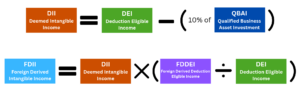
In 2025, FDII was replaced by the Foreign Derived Deduction Eligible Income (FDDEI) under changes made by the One Big Beautiful Bill Act (OBBBA), which simplified the calculation of the deduction.
The OBBBA modifies the deduction as follows:
The FDDEI deduction is available only to domestic C corporations. To claim the deduction, corporations must demonstrate that the income is derived from qualifying foreign transactions and satisfy applicable foreign-person and foreign-use requirements. This involves the U.S. taxpayer having to obtain and keep documentation including contracts, purchase orders, shipping records, invoices, and customer certifications so as to prove that the income received meets the foreign-person and foreign-use requirements.
As the name suggests, foreign use is a key requirement for a corporation to qualify for the deduction. In general, property is for foreign use when it is sold, leased, licensed, or otherwise transferred to a foreign person and is ultimately used outside the United States.
With respect to services, qualification generally depends on the location of the customer or the property receiving the service. If the services provided are to customers or relate to property outside the United States, the service-providing corporation should qualify for the FDDEI deduction.
The FDDEI deduction is also available where the property sold or service provided are made to a related party such as a foreign affiliate; however, additional rules will apply to related party transactions. In such transactions, the U.S. corporation must be able to show that the property or services were used exclusively outside of the U.S. and satisfy any applicable foreign-use requirements.
The Treasury Department and the IRS issued proposed regulations on August 26, 2026, which clarify Internal Revenue Code (the “Code”) Section 250, which was inserted into the Code by the OBBBA. These proposed regulations, amongst other things, narrow the category of income eligible for FDDEI by generally excluding income and gain from certain transfers of intellectual property and certain sales of depreciable, amortizable, and depletable assets.
The proposed regulations would provide a narrower definition of “sale or other disposition” for purposes of Section 250(b)(3)(A)(i)(VII) than the broader sale concept used elsewhere in the Section 250 regulations. Under the proposed rule, the characterization of a transaction as a sale or other disposition would be determined under general federal income tax principles. A transaction characterized as a lease or license under general tax principles would not be treated as a sale or other disposition, even if it involves intellectual property or software.
Under Section 1.250(b)-1(h)(1) of the Proposed Regulation, property sales income would exclude income and gain derived from the sale or other disposition of:
In general, income from the disposition of intellectual property or productive business assets would be excluded from deduction eligible income (DEI) while income from ordinary sales activity with foreign markets can continue to qualify for FDDEI treatment.
The proposed regulations provide several important clarifications, including that:
The proposed regulations also contain a related-party anti-abuse rule to prevent taxpayers from avoiding the exclusion of depreciable, amortizable, or depletable property through related-party transfers. Under this proposed rule, property that has been treated as “other excluded property” in the hands of a related party would retain its depreciable, amortizable, or depletable status when transferred to another member of the group if both of the following conditions are met:
If you have any further questions regarding the tax regulations applicable to foreign derived income, please contact Ian Shane.