
by Charlene Valdez Warner
Senior Associate, Litigation
I recently traveled to Rusutsu Resort in Hokkaido, Japan—a winter wonderland known for its deep powdered terrains and tree runs. Over several days, I spent hours snowboarding through trees, carving down long, sweeping groomers, and occasionally, tumbling into snowbanks that felt more like a fluffy bed than ice. It was the kind of trip that reminds you why you love a hobby in the first place: the mix of challenge and fun.
Snowboarding is not something I grew up doing. Having been born and raised in the Philippines, a country blessed with beautiful beaches and tropical heat—but no snow—I only picked up snowboarding when I moved to the U.S. over a decade ago and married a Coloradoan. This sport has definitely taught me how to embrace winter despite the freezing temperatures. What surprises me is how many of the skills I picked up from the slopes translate to my life as a lawyer and litigator.
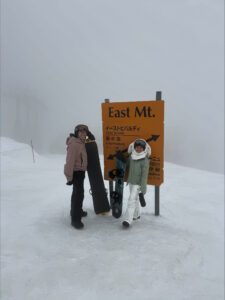
On top of East Mountain, Rusutsu.
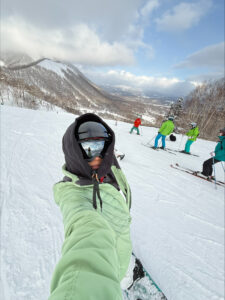
Always watching out for skiers!
A good day on the slopes starts long before the first lift ride: you check the snow conditions, layer appropriately, and study the trail map. When I’m well prepared, the runs feel smoother. Litigation and lawyering in general are similar. The smoother moments—effective depositions, clear arguments, productive negotiations—almost always come after the intense pre-work behind the scenes, such as legal research, discussions of strategy, and organization. While preparation does not guarantee a perfect ride or a perfect proceeding, it dramatically increases the odds in your favor.
While snowboarding requires balance, control, and consistent technique, it also demands flexibility. You can’t always predict the terrain because of a number of factors like snow coverage, crowds, and lighting conditions, among others. The more rigid you are, the more likely you are to catch an edge and succumb to a wipeout. The same is true in law. Strong fundamentals such as knowing the rules, mastery of the record, and communicating your argument clearly are non-negotiables. Still, one must be flexible and be able to adjust when, for instance, opposing counsel surprises you, or the judge asks an unexpected question, or discovery takes an unanticipated turn. The ability to stay grounded but adjust strategy quickly makes a huge difference both on the slopes and in the courtroom.
On the slopes, conditions can shift within minutes. In Hokkaido, several clear mornings turned into whiteouts with very limited visibility. In Colorado, a friendly powdery run could become icy and slick by the afternoon. As a litigator, I see the same rapid changes over the course of a case due to a number of factors, including evolving client needs that could necessitate sudden strategic pivots. Snowboarding has helped me embrace change rather than fear it: I learn the environment, try to respond effectively as quickly as possible, and stay calm even when visibility drops. At the end of the day, you’ve got to trust your training and your legs.
In many ways, snowboarding has become more than a hobby. It’s a reminder of the mindset I want to bring to my work as a lawyer: be prepared, stay grounded, remain flexible, and adapt to whatever comes next. And, whenever possible, I try to enjoy the ride along the way.
Inspired by Law360’s Series “My Hobby Makes Me A Better Lawyer”
 Charlene Valdez Warner